





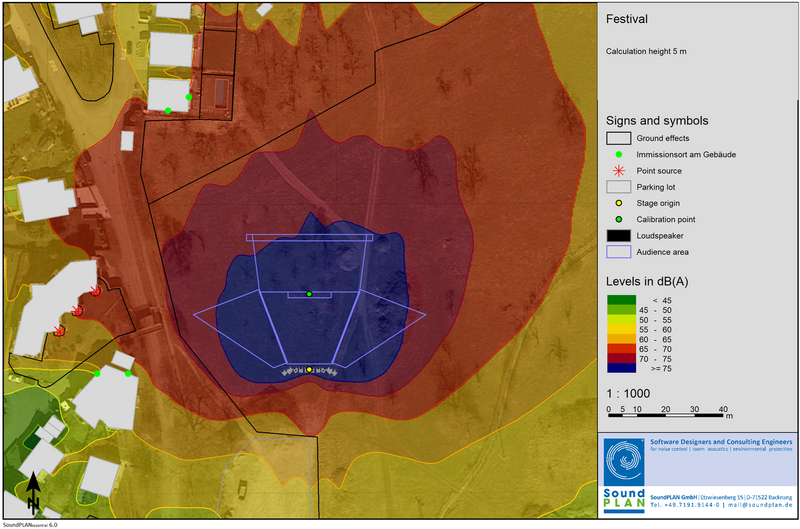
New possibilities for more accurate predictions
The acoustic planning of open-air events places particular demands on the model. Sound reinforcement systems, stage structures, tents, temporary barriers, and the surrounding environment all need to be represented as realistically as possible.
SoundPLAN provides powerful tools for the detailed calculation and assessment of sound immissions from concerts, festivals, and other outdoor events.
Direct import of loudspeaker systems
The open System Design Exchange format, or SDE, enables system data to be imported directly from the planning software of leading loudspeaker manufacturers, including d&b audiotechnik and L-Acoustics.
Complete sound system configurations can be transferred to the calculation model together with their geometric arrangement and acoustic properties. This reduces manual modeling effort and improves consistency between sound system design and environmental noise prediction.
SoundPLAN also supports the import of CLF and XHN files. Frequency-dependent 2D and 3D directivities can be imported or defined individually.
Why SDE is needed
Previously, transferring complete sound system designs into environmental noise prediction software often required several export and conversion steps. Loudspeaker positions, spectra, directivities, and system settings had to be transferred or recreated manually, resulting in additional work and potential sources of error.
SDE provides a standardized exchange format for complete sound system configurations. Designs can be exported from the manufacturer’s system design software and imported directly into environmental noise prediction software.
In addition to the data format, SDE defines a consistent calculation methodology for coherent sound sources. Phase relationships, frequency-band averaging, statistical decoherence effects, and standardized calibration procedures can therefore be considered consistently.
This creates a more reliable and transparent workflow between sound system designers, environmental noise consultants, event organizers, and public authorities.
Further information about the collaboration between d&b audiotechnik, L-Acoustics, and SoundPLAN, including technical specifications and a detailed description of the SDE file format, is available at www.sde-info.com.
The English Technical Information about the SDE format and its implementation in SoundPLANnoise 9.1 is available here.
Realistic consideration of phase effects
Modern sound reinforcement systems often consist of several coherently driven loudspeakers whose sound contributions interact at the receiver.
SoundPLANnoise and SoundPLANessential+ enable phase-related calculations of these systems. This allows frequency-dependent constructive and destructive interference to be represented more realistically than with purely energetic addition.
This is particularly relevant for:
- line-array systems and loudspeaker groups such as main, fill, and delay systems
- complex system configurations with defined time delays and phase relationships
Frequency-band averaging and statistical decoherence account for the fact that interference effects are smoothed across a frequency band and generally weaken over longer propagation distances due to atmospheric fluctuations.
Standardized calibration
SDE uses a defined calibration point, a target level, and an input spectrum to calibrate the sound system consistently.
The calibration point is defined in the system design software and stored in the SDE file. It is typically located at the Front of House position or another representative location in the audience area.
The input spectrum represents the electrical signal supplied to the sound system, while the system response determines how this signal is reproduced. This separates the signal content from location-specific interference effects and enables different system configurations to be compared consistently.
Sound-transmitting structures
Temporary structures such as tent walls, stage coverings, tarpaulins, or lightweight partitions are often not completely soundproof.
In SoundPLANnoise, such elements can be defined using frequency-dependent sound insulation values. This allows both their screening effect and the transmission of sound through the structure to be taken into account.
Real event configurations can therefore be modeled much more accurately.
Calculations according to relevant standards
Outdoor sound propagation can be calculated according to methods such as ISO 9613-2, CNOSSOS-EU, or Nord2000. Depending on the project, assessment criteria may be based on regulations such as the German TA Lärm, recreational noise guidelines, or DIN 15905-5.
More accurate planning and reliable decisions
Detailed modeling helps event organizers, acoustic consultants, and public authorities identify potential conflicts at an early stage.
Possible calculations include:
- sound levels within the audience area
- sound immissions at neighboring buildings
- the effects of different loudspeaker arrangements
- the effectiveness of noise-control measures
- the influence of temporary structures
- alternative operating and optimization scenarios
SoundPLAN therefore provides a reliable basis for the safe and cost-effective planning of open-air events.